Kopikfon™
Thirteen months: a person, a cell and the state’s imagination
According to my own account, I spent the first thirteen months after my arrest in almost complete isolation, with no visual contact with other prisoners and no ordinary interaction. Organised, as I assume, at the instigation of Oberstaatsanwalt Wachs (senior public prosecutor), and implemented in JVA Moabit under the then head of security, Kopik.
The system trusted me as much as one normally trusts an unattended suitcase at a railway station. Daily food distribution became a small counterintelligence operation: the plate could not be passed directly to the fellow prisoner serving the food. A guard first received it, checked it for hidden messages, passed it on, and the filled plate was returned to its owner.
A rare form of communication: no message, no recipient, no channel, yet the channel was checked every day. At the same time, as I recall, the cell was constantly searched. Nobody went out, nobody met anyone, and the state nevertheless remained vigilant. The logic was impeccable in its self-containment: if nothing was found, the search had not been thorough enough. If nothing was found again, the danger was especially well hidden.
Author’s accountAn innovation from a single sheet
At some point I decided to help the system achieve a result. I took a sheet of A4, folded it into a rectangle about the size of an iPhone and drew a device that I called Copec-Phone v.3 — as can be seen, the display reads “Copec-Phone V.3”.
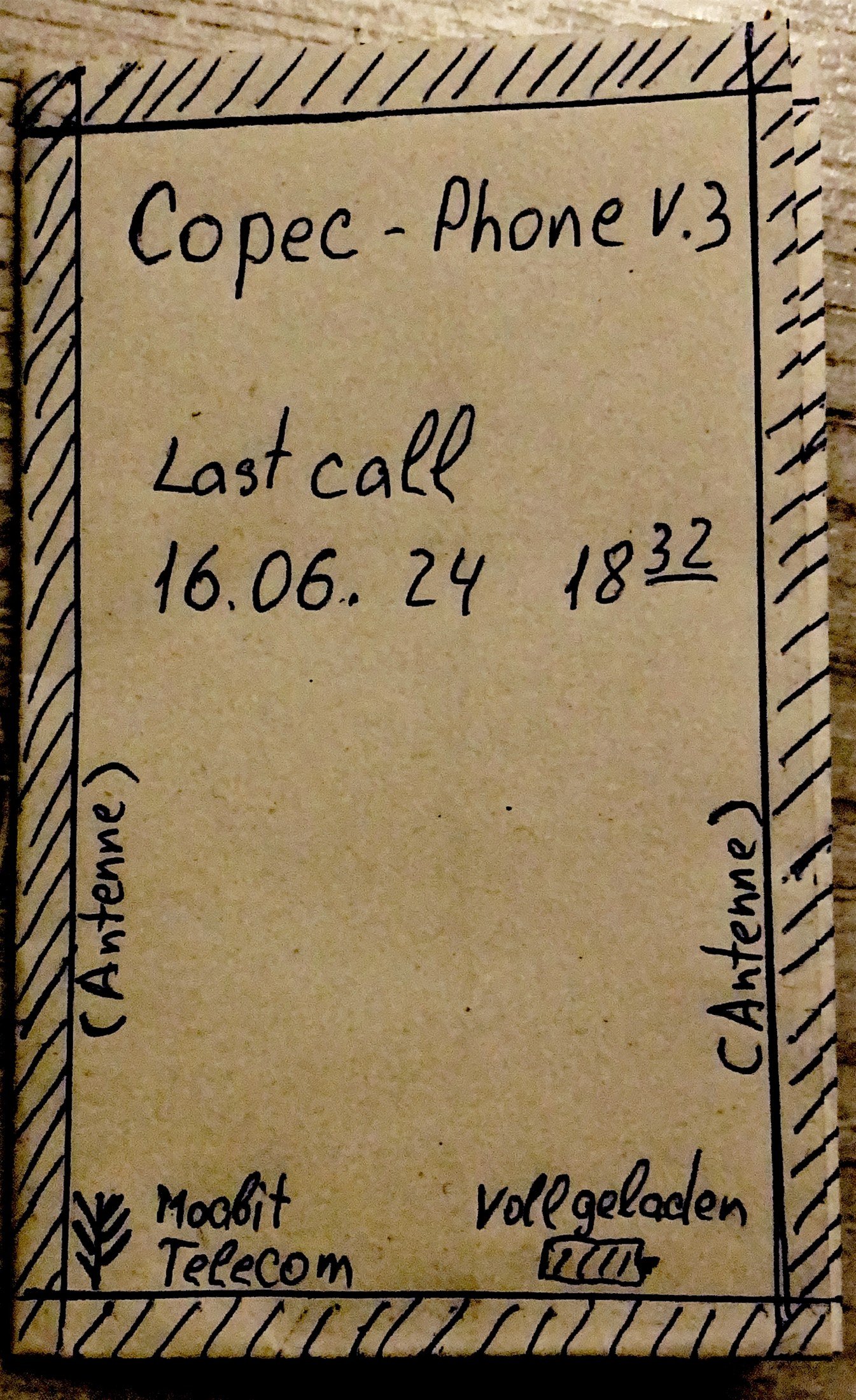
The technical specifications were impressive: a paper casing, a ballpoint-pen display, network operator “Moabit Telecom”, battery status “fully charged”, two hand-drawn antennas, an IMEI and a serial number, also drawn. Power consumption: zero. Ability to make calls: zero. Ability to set an administrative machine in motion: maximum.
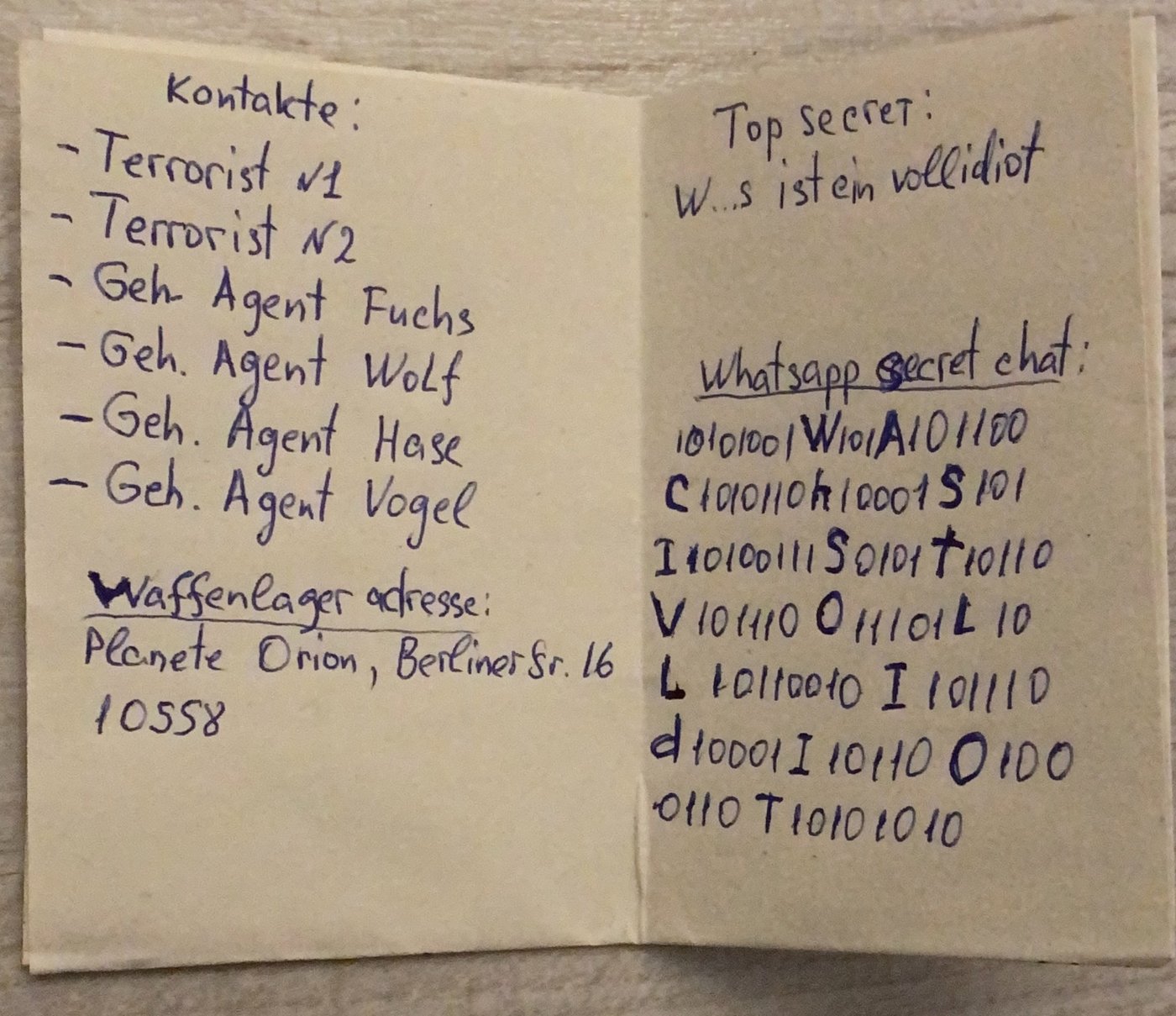
Inside is a parody contact list: “Terrorist N1”, “Terrorist N2”, secret agents Fuchs, Wolf, Hase and Vogel, and a “weapons store” on planet Orion. On the right is a “secret chat” and an unflattering assessment of a person identified by a single letter.
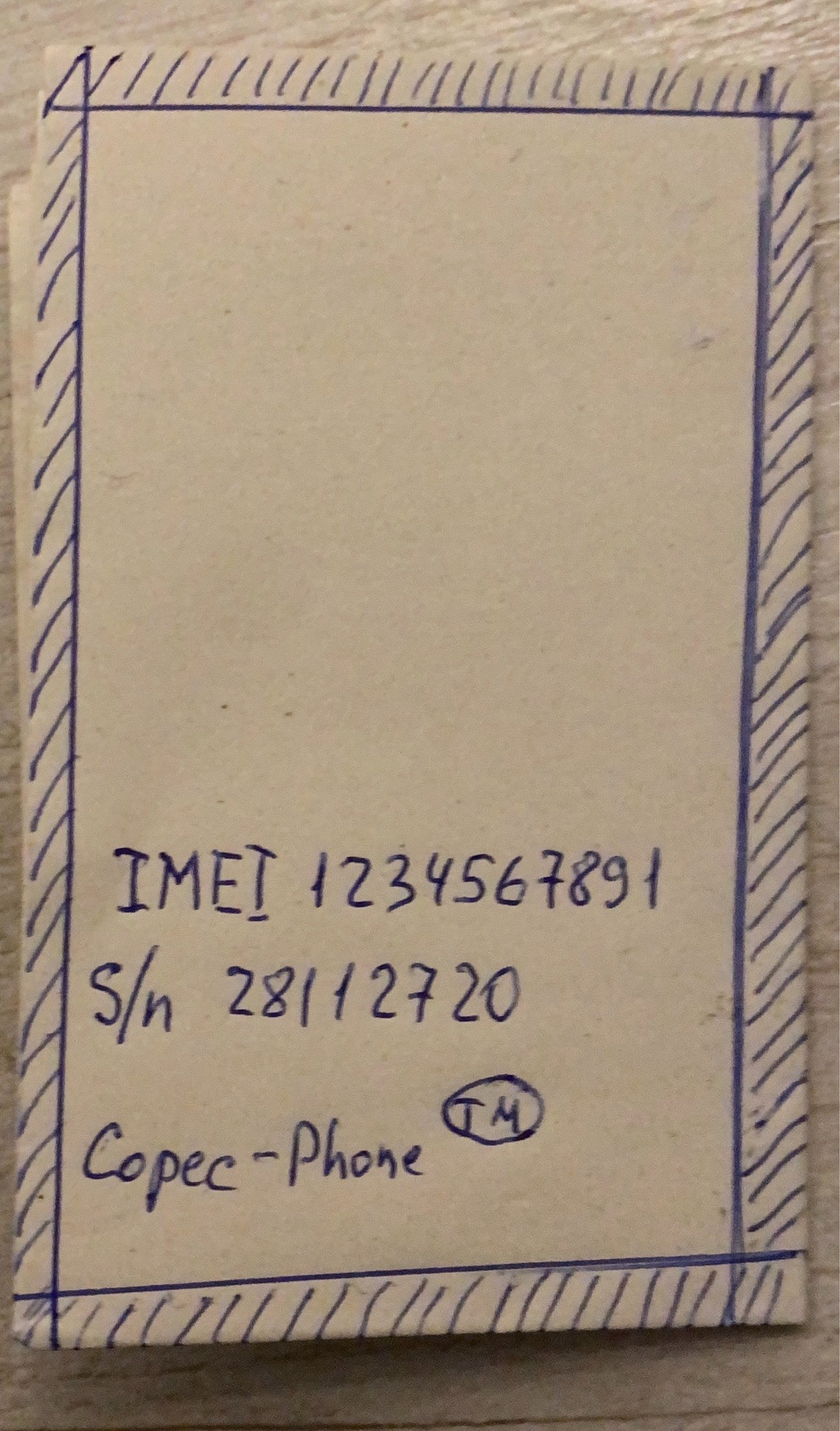
It is important not to miss the essential point: this is not an electronic device cleverly disguised as paper. It is paper cleverly disguised as a joke. Yet this is precisely where the Berlin security authority demonstrated its ability to see deeper than the material itself.
DocumentOperation “Mattress”
The paper phone lay under the mattress, a place hardly describable as an inaccessible archive during regular searches. It was found after a few days. The official report of 03.07.2024 records the discovery under the mattress of a “homemade mobile phone made of paper”, containing terms such as “Terrorist N1”, “Terrorist N2”, “weapons store” and “weapons supplier etc.”; the reporting officer had found this “odd”.
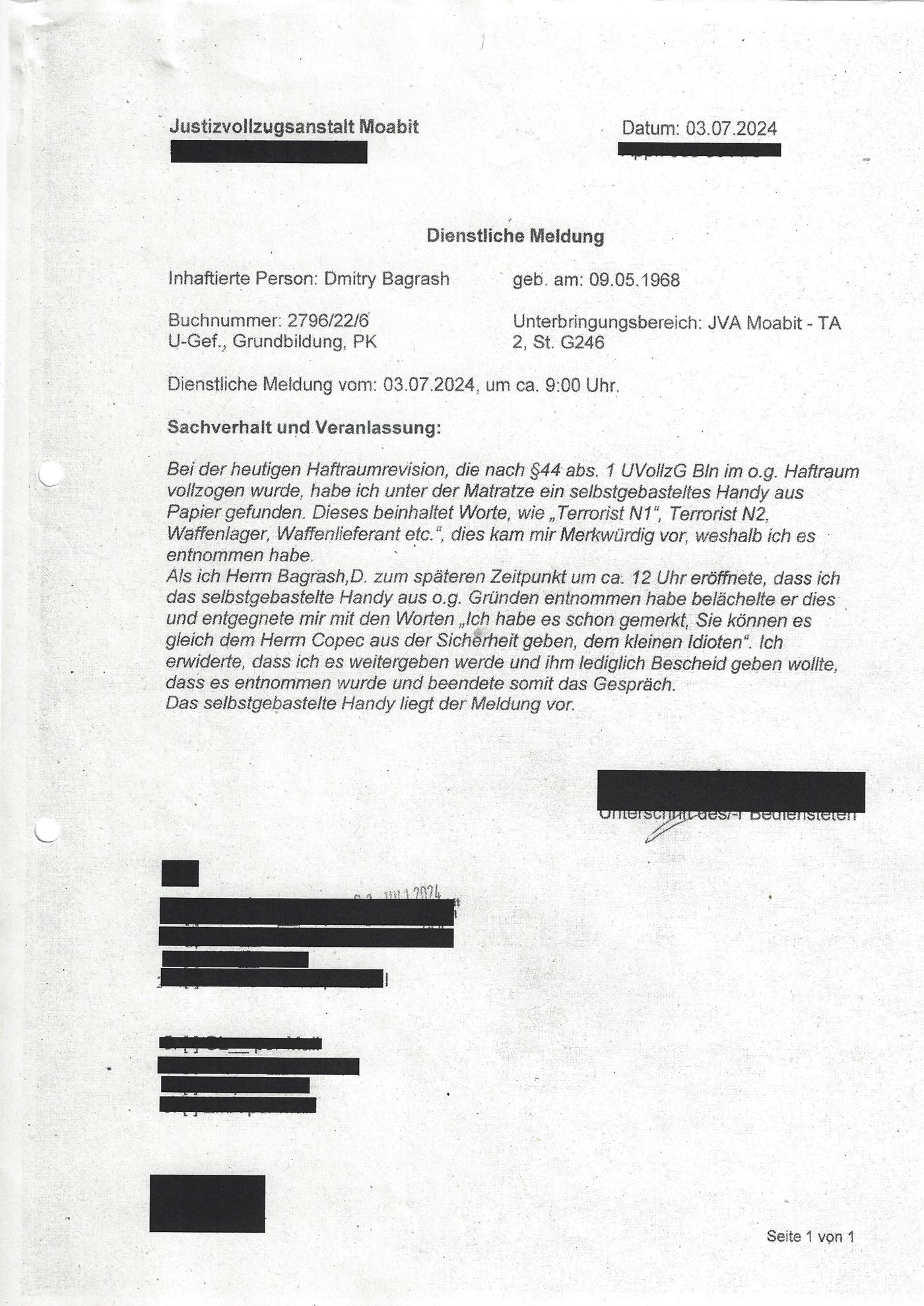
Particularly noteworthy: the report also records my reaction when told that the paper phone had been removed. According to it, I merely smiled in amusement; the reported reply was that I should “give it straight to Mr Copec from security, the little idiot”. An official report documenting an insider nickname for its own security department is, in my view, at least as revealing as the paper phone itself.
An ordinary story could have ended here. A staff member could have picked up the sheet, read the writing, sighed, smiled and put it in a file called “Prisoners sometimes joke too”. But bureaucracy has no such file.
DocumentThe moment paper became mobile telecommunications
In the official letter from JVA Moabit of 09.08.2024, the object is described as the “self-made and seized ‘mobile phone’”. Its return was refused under § 42 Abs. 1 UVollzG Bln (security and order in the prison). The examination was said to have found that the paper phone contained “incorrect facts about a staff member employed in JVA Moabit and political content” that “contravened the prison rules”. A “collection of personal data and content with militant overtones, such as the terms ‘terrorist’ and ‘weapons’ in this case”, undermined “the principle of prison life”, with reference to § 186 StGB.
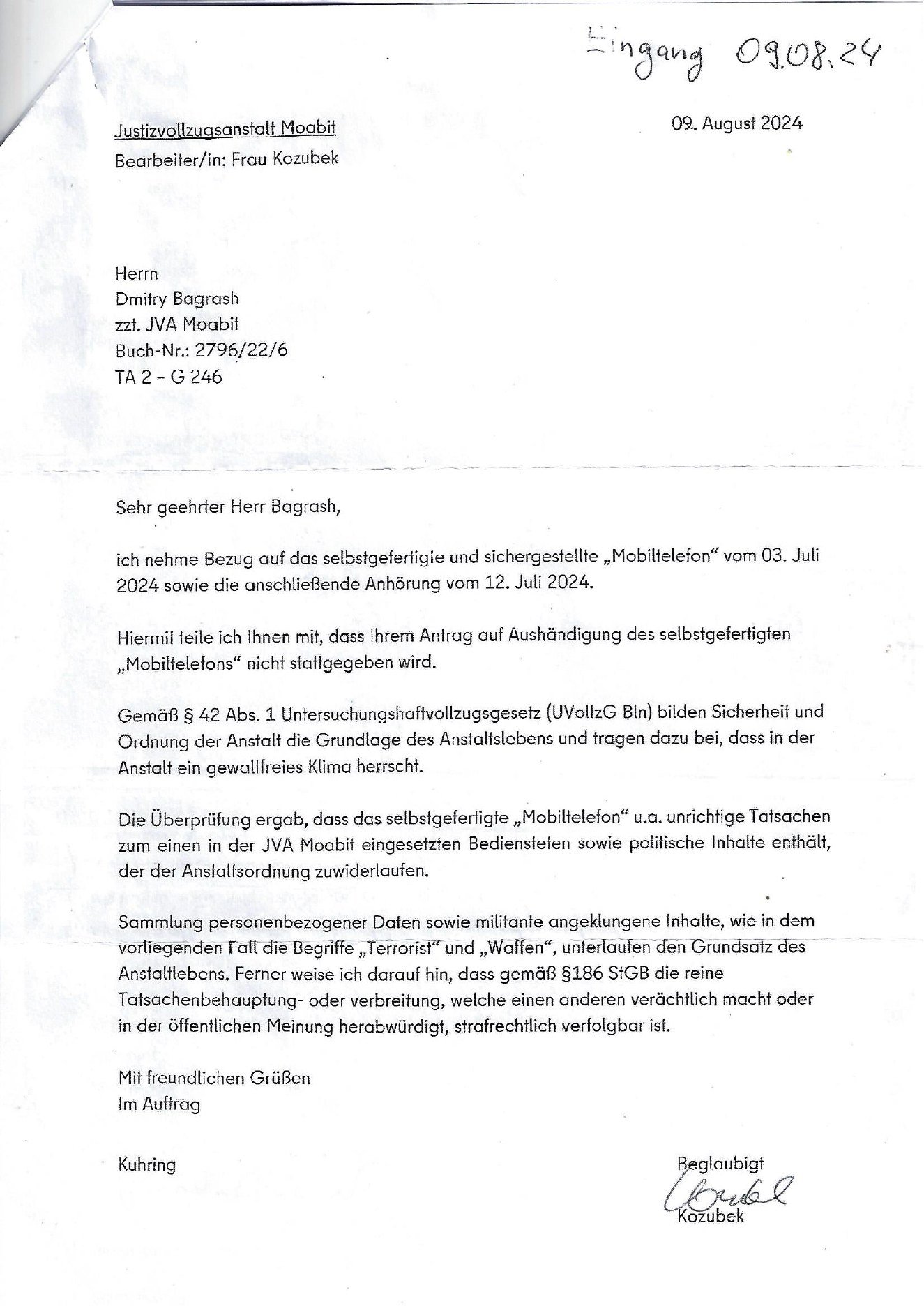
There it is, the historic moment. Before the letter, there was a sheet of paper with drawings. After the letter, there is a mobile phone, at least in administrative reality. Apple spends billions developing devices. JVA Moabit solved the task with a single noun in quotation marks.
Author’s account / satireA device that does not ring but triggers meetings
Kopikfon™ lacked every property of a phone apart from its outward shape and the word “Phone”. It could transmit neither sound nor data nor coordinates. But it had a unique function: making grown adults with official positions and powers seriously discuss how dangerous a paper rectangle was.
Suggested advertising slogan: Kopikfon™. No network. No signal. Common sense out of range.
SatireService instructions for handling dangerous paper
To prevent similar threats from catching the prison unprepared, the following is suggested: check whether the sheet connects to WLAN. Try inserting a SIM card; do not use force if there is no slot. Press the drawn button; if it cannot be pressed, note the possible use of advanced sensor technology. Call the device; if it does not ring, assume an enhanced secrecy mode. Check the battery: classify the drawn “fully charged” symbol as especially suspicious, since the device apparently never discharges. Convene a meeting. Write a letter stating that paper threatens the foundations of prison life. Do not return the exhibit: it could be used in a book, and that would already be contact with the outside world.
Why this paper phone is not a side joke
I deliberately make a serious comparison here because it rests on the same method that I also see at the core of my criminal proceedings: first an object is assigned a dangerous meaning, then that interpretation is officially documented, and the document subsequently serves as evidence that the original interpretation was reasonable.
I find precisely the same pattern in my own judgment of 22.07.2024 concerning the device found in Lepsiusstraße:
| Object | What physically existed | What was attributed to it |
|---|---|---|
| Kopikfon | A sheet of paper with drawings | A “self-made mobile phone”, a danger to security and order |
| Lepsiusstraße device | A device whose additional electronic components, according to the judgment itself, “could no longer be established afterwards” (judgment, p. 29) | A timer or remote detonator activated by me — with intent to commit attempted murder |
Even the Bundeskriminalamt’s own expert (BKA, Federal Criminal Police Office) could not explain at trial, as I recall and as is also reflected in substance in the judgment, what the circuit board was for, and smiled when asked whether a fire could actually have started at the specific location. If even the BKA’s own expert cannot determine the function of a real circuit board, while JVA Moabit treats a drawn “fully charged” symbol as independent evidence of danger, then for me the difference between the two cases is chiefly one of consequences, not method.
That is precisely why the corresponding section on this website and in my Google Docs materials is called “Deception as modus operandi” — not to heighten the rhetoric, but because the same method, literal reading plus an official document, repeatedly appears in my experience in situations where common sense should have been the only authority needed. Someone who recognises a mobile phone in paper is, I believe, capable of recognising a murder weapon in a metaphor too.
Detailed analysis supported by documents: Judgment of 22.07.2024, fully annotated — particularly pages 14 (electronics), 29–30 (expert report).
Afterword about the sweet
In an earlier account, I described another action: when the regular searches became less frequent, I asked for them twice a day. Without work, I said, this would add variety to my daily routine. Out of hospitality and respect for their important duties, I promised staff a sweet on the table each time. Afterwards, as I recall, the searches stopped. Perhaps the system can survive a paper phone. But the prospect of finding a sweet at the scene every day is psychological pressure for which no service instruction prepares anyone.
Conclusion
Kopikfon does not automatically prove that the entire criminal proceedings are untenable. It proves something narrower and therefore more tangible: a specific state institution really did officially classify a sheet of paper as a homemade mobile phone and justify its refusal to return it on security and order grounds. This is not an anecdote invented afterwards. It is an anecdote for which the state itself issued a certificate of authenticity. And if a system can see a means of communication in paper, it is worth examining closely what else it saw in metaphors, political slogans and a canister found days later.
Kopikfon bore one honest inscription: Last call. Perhaps that was the last call to common sense.