Each of the following decisions is read twice here: once for what it means in my case — and once as a general rule as it would apply to anyone else in Germany if it stands. I do not assess whether a judge or an authority acted wrongly. I ask the question that follows from the rule itself and identify who can answer it.
N-01
Access to the court registry officer
Kammergericht Berlin (Berlin Higher Regional Court), 5th Criminal Division, order of 12.06.2026, file reference 5 Ws 17/26 (Annex 142_F2). Signed: Dr. Mann, Kelting-Scholz, Dr. Schäuble.
Quotation
‘…the right to a decision free from errors in the exercise of discretion on an application for an escorted trip to the court registry officer becomes a right to the escorted trip.’ ‘A “preliminary examination” of whether the legal remedy is admissible or even useful is not within its remit.’ ‘…that Justizvollzugsanstalt Heidering (Heidering correctional facility) … rightly decided to grant requested escorted trips to the court registry officer “immediately” and “unconditionally” in future.’
Anyone demonstrably able to formulate a legal remedy themselves has no interest in a declaratory finding concerning the denied escorted trip. If this holds: The better a prisoner defends himself, the less access to court he is entitled to.
Why does a prison change its practice to ‘immediately’ and ‘unconditionally’ if the previous practice was lawful?
Who can answer: Senate Department for Justice (§ 151 StVollzG) · Petitions Committee (§ 5 para. 1 points a, b PetG Bln)
Kammergericht Berlin (Berlin Higher Regional Court), 3rd Criminal Division, order of 31.10.2025, file reference 3 Ws 48/25 + 49/25 (Annex 82_F2), section I.1. Signed: Grieß, Sandherr, Brandt. Without information on legal remedies.
Fact
On 30.07.2025 — 373 days after pronouncement and 84 days after the Bundesgerichtshof (Federal Court of Justice) decision — the list of provisions applied was inserted into the judgment of 22.07.2024 as a ‘correction of a clerical error’. The complaint against this was dismissed as already inadmissible.
Quotation
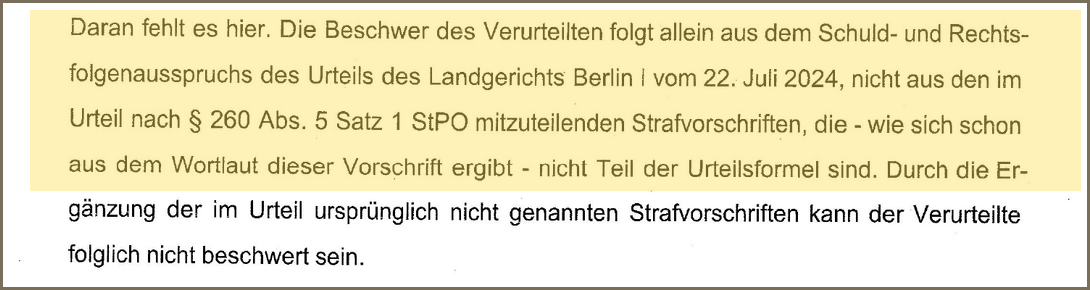
‘The adverse effect on the convicted person arises solely from the judgment’s pronouncement on guilt and legal consequences … not from the criminal provisions to be stated in the judgment under § 260 para. 5 sentence 1 StPO, which — as already follows from the wording of that provision — are not part of the operative formula of the judgment.’
§ 260 para. 5 StPO · Principle that correction after pronouncement is possible only for an obvious clerical or pronouncement error (BGH, 11.11.2020 – 2 StR 48/20)
Subsequent insertion of the list of provisions does not affect the convicted person — so there is no legal remedy against it. If this holds: A final judgment can be substantively supplemented after completion of the appeal on points of law (Revision), and no one can have that addition reviewed.
Is determining the complete list of provisions for the first time 373 days after pronouncement an obvious clerical error — or a new thought process for which the correction procedure is not designed?
Self-objection: Under the prevailing view, mere defects in the list of provisions applied do not in themselves establish grounds for an appeal on points of law (Revision). That is the objection against me, and I state it myself here. My allegation concerns not the absence of the list but the means and timing of its insertion.
Who can answer: Bundesverfassungsgericht (Federal Constitutional Court) (proceedings pending) · Petitions Committee within service supervision (§ 10 para. 1 PetG Bln)
The same Kammergericht (Berlin Higher Regional Court) order of 31.10.2025, section I.2.
Fact
The complaint of 26.08.2025 was not submitted to the court hearing complaints. In a letter of 23.09.2025, the Regional Court (Landgericht) stated that it had forwarded the letters to the Generalstaatsanwaltschaft (Prosecutor General’s Office). They were not submitted to the court hearing complaints.
Quotation
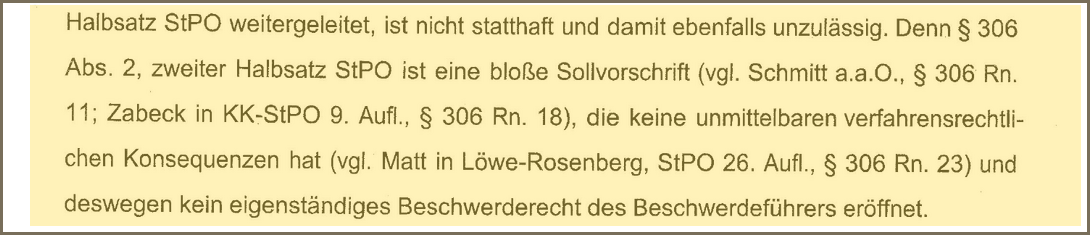
‘For § 306 para. 2, second half-sentence StPO is merely a provision to be followed as a rule … which has no direct procedural consequences … and therefore creates no independent right of complaint for the complainant.’
§ 306 para. 2 half-sentence 2 StPO — submission ‘immediately, at the latest before three days have elapsed’ · Art. 101 para. 1 sentence 2 GG · Art. 19 para. 4 GG
The duty to submit exists, but its breach gives the affected person no legal remedy. If this holds: An originating court can effectively suspend the statutory route through the courts by not passing on a document.
The duty exists and its breach can be established by a court — but the affected person has no remedy against it. Who then enforces the duty?
Distinction: The Bundesverfassungsgericht (Federal Constitutional Court) ruled that not every breach of the three-day deadline in itself violates fundamental rights (order of 23.01.2023 – 2 BvR 1343/22); that case involved a delay of about a month. At the same time, the same court confirmed that § 306 para. 2 half-sentence 2 StPO had been breached and that the Kammergericht (Berlin Higher Regional Court) had rightly established this. My case concerns no delay: the complaint was not submitted late, but not submitted at all — and instead sent to another body.
Who can answer: Bundesverfassungsgericht (Federal Constitutional Court) · Petitions Committee (§ 10 para. 1 PetG Bln)
N-04
Fully investigated — without examining the applicant’s own evidence
Landgericht Berlin I (Berlin Regional Court I), 95th Sentence-Enforcement Chamber, order of 31.07.2026, file reference 595 StVK 68/26 Vollz (Annex 157_F2), judge Raschke. Received 11.08.2026.
Fact
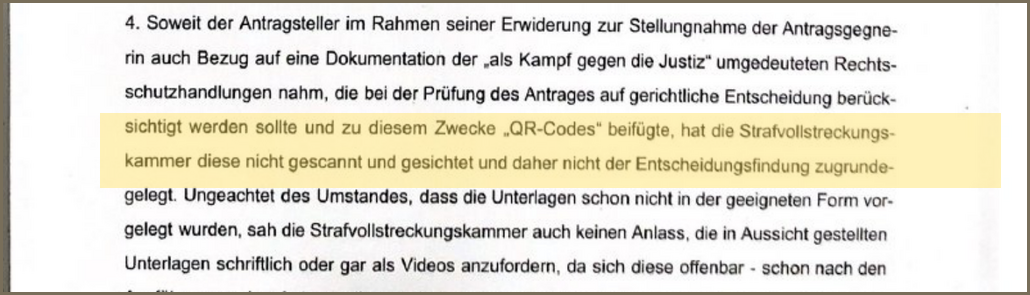
The Chamber examines whether the prison authority proceeded on correctly and fully established facts and answers yes. Elsewhere in the same order, it records that it did not itself scan and examine the documentation of the applicant’s legal-protection actions attached as ‘QR codes’ — submitted to counter the characterisation ‘fight against the justice system’.
Quotation
‘…the Sentence-Enforcement Chamber did not scan and examine these and therefore did not use them as a basis for its decision.’
The completeness of the authority’s factual basis is confirmed while the applicant’s own evidence remains unexamined because it was supposedly submitted ‘in an unsuitable form’. If this holds: Anyone submitting counter-evidence in the wrong form can thereby effectively have it excluded from the proceedings — regardless of its content.
Would the assessment of completeness have differed if the Chamber had actually examined the offered documentation?
Who can answer: Kammergericht (Berlin Higher Regional Court) in proceedings on the complaint on points of law (Rechtsbeschwerde) (deadline 11.09.2026) · Petitions Committee (§ 10 para. 1, § 10 para. 3 PetG Bln)
The expert report is unnecessary because the outcome is settled
Kammergericht (Berlin Higher Regional Court), 2nd Criminal Division, 2 Ws 111/26, order of 18.08.2026 (Annex 194_F2), judges Herb, Kupferschmidt, Hollering.
Fact
The Division considers it unobjectionable that an expert report under § 454 para. 2 StPO was not obtained: the possibility of suspension was said to be ‘entirely remote’ and ‘ruled out from the outset’. The circumstances said to support this are the attributions from the diagnostic procedure of 17.04.2026 — feelings of anger, experiences of hurt, an urge for retribution. No document in the proceedings identifies evidence for these attributions. The only standardised measurement, LSI-R 20, points in the opposite direction and is not mentioned in any decision after 17.04.2026.
A prognosis is settled; because it is settled, it need not be examined; because it is not examined, it remains settled. If this holds: Any attribution once entered in the file becomes unassailable as soon as it is worded clearly enough — and the more sharply it is worded, the less evidence is required for it.
What verifiable evidence supports the assumption said to make examination unnecessary?
Who can answer: Bundesverfassungsgericht (Federal Constitutional Court) (constitutional complaint of 02.09.2026) · Petitions Committee (§ 3 PetG Bln)
Landgericht Berlin I (Berlin Regional Court I), 589 StVK 86/26, order of 24.06.2026 (Annex 139_F2), judge Lechner. Related observations by the Generalstaatsanwaltschaft (Prosecutor General’s Office) of 26.05.2026.
Fact
Suspension of the remainder of the sentence on probation is refused; the lack of ‘work on the offence’ contributes to the reasons. In the same matter, the Generalstaatsanwaltschaft (Prosecutor General’s Office) writes that a full admission of guilt is not an indispensable condition and denial alone cannot support a negative social prognosis — yet uses the denial nevertheless.
§ 57 StGB · nemo tenetur se ipsum accusare · Art. 6 para. 2 EMRK · Art. 2 para. 1 in conjunction with Art. 1 para. 1 GG
Anyone denying the act has not worked through it; anyone who has not worked through it remains in custody. If this holds: The right not to incriminate oneself ends with the judgment and is then converted into time in custody.
If an admission of guilt is expressly not required and denial alone cannot support the decision — what part of the refusal remains once denial is removed from the calculation?
Who can answer: Kammergericht (Berlin Higher Regional Court), 2 Ws 111/26 — decided on 18.08.2026, complaint dismissed · now Bundesverfassungsgericht (Federal Constitutional Court) (constitutional complaint of 02.09.2026) · Petitions Committee (§ 10 para. 3 PetG Bln)
JVA Heidering, decision of 22.07.2026 (Annex 152_F2), ‘on behalf, Lohmeier’. Video calls banned until 16.10.2026 — set aside as unlawful by Landgericht Berlin I (Berlin Regional Court I) order of 11.09.2026 (595 StVK 126/26 Vollz).
Fact
The decision expressly names as the occasion an email of 12.07.2026 addressed, among others, to the press office of the Senatsverwaltung für Justiz (Senate Administration for Justice), describes public use as abuse and justifies the ban in part by saying that I still do not engage with the offence.
Approaching the press and supervisory authority is a reason to remove video contact with family for three months. If this holds: The exercise of petition and complaint rights is answered by removal of family contact. Berlin petition law rests on the principle that no one may suffer a disadvantage from it.
By what route did an email addressed to the Senate Administration’s press office become part of the prison’s basis for its decision? (According to my sent mail, the same email also went to the prison itself. I demand clarification; I do not establish it.)
Who can answer: Senate Department for Justice · Petitions Committee (§ 5 para. 1 PetG Bln) — Landgericht Berlin I (Berlin Regional Court I) itself set aside the ban as unlawful on 11.09.2026 (595 StVK 126/26 Vollz), but left this question about the information route open.
The application of 11.06.2025 to be brought before the court registry officer was decided only on 04.11.2025. On 11.08.2025 — the eighth day of a hunger strike — the escorted trip took place; at the same time, it was announced orally that no written decision would be issued (Annex 67_F2). The prison informed the court that the case had been discussed with the Senate Administration on 11.08.2025 and a common approach developed (Annex 84_F2).
§ 108, § 109 StVollzG · Art. 19 para. 4 GG
Without a written decision, there is no measure against which an application for a judicial decision could be directed. If this holds: An authority can close the route to court by writing nothing.
What approach was agreed on 11 August 2025 — and where is it recorded?
Who can answer: Petitions Committee by requesting the record (§ 5 para. 1 point b PetG Bln)
Senatsverwaltung für Justiz und Verbraucherschutz (Senate Administration for Justice and Consumer Protection), letter of 05.05.2025 (Annex 56_F2).
Quotation
‘Only once the prison management has conclusively considered your concern and made a decision will the Senate Administration … be able to review the prison management’s decision.’
Fact
Three personal submissions to the Senator (24.04., 05.05., 05.06.2025) reached her office and were each forwarded to the body against which the complaint was directed. The final written decision on which supervisory action is made conditional was expressly refused by the prison on 11.08.2025.
The supervisory authority acts once the prison has decided. The prison does not decide. If this holds: Substantive administrative supervision of prisons is structured so that the body supervised itself determines when supervision begins.
How many substantive decisions has the supervisory authority made in this matter between April 2025 and today?
Who can answer: Senate Department for Justice · Petitions Committee (§ 5 para. 1 point a PetG Bln, report within three weeks under § 7 para. 3 PetG Bln)
The Russian Federation delegation named Unkremlin e. V. before the OSCE Permanent Council on 23.09.2021 and again on 08.04.2022 (PC.DEL/1483/21; PC.DEL/526/22 — second meeting on 07.04., document distributed by the conference service the following day). Such statements are distributed by the OSCE conference service to participating States and are publicly available; Germany is a participating State. The second statement is dated sixteen days before the time at which, according to the judgment’s findings, the device is said to have been placed.
§ 160 para. 2 StPO — duty to investigate exculpatory matters too · § 244 para. 2 StPO
A publicly accessible statement by a foreign state about the defendant’s organisation, sixteen days before the alleged act, had no discernible significance for the proceedings. If this holds: The duty to investigate ends at the boundary of what the prosecuting authority considers relevant — even where the only plausible alternative explanation lies.
Did the prosecuting authority know the statement of 08.04.2022 — and is it in the file? I make no claim about this. I place three possibilities side by side, and one is true.
Who can answer: Generalstaatsanwaltschaft Berlin (Berlin Prosecutor General’s Office) (§ 147 StPO) · Petitions Committee (§ 5 para. 1, § 10 para. 1 PetG Bln) · the trial record in 522 Ks 5/23
The diagnostic procedure of 12.03.2026 (Annex 137_F2) and the sentence implementation and reintegration plan of 17.04.2026 (Annex 115_F2) bear no signature and no name of a responsible person; they end ‘on behalf / E4’. All the negative assessments later carried into the sentence implementation plan, the Generalstaatsanwaltschaft’s (Prosecutor General’s Office) observations and the decision on liberty originate in the diagnostic procedure.
Quotation from the order of 31.07.2026
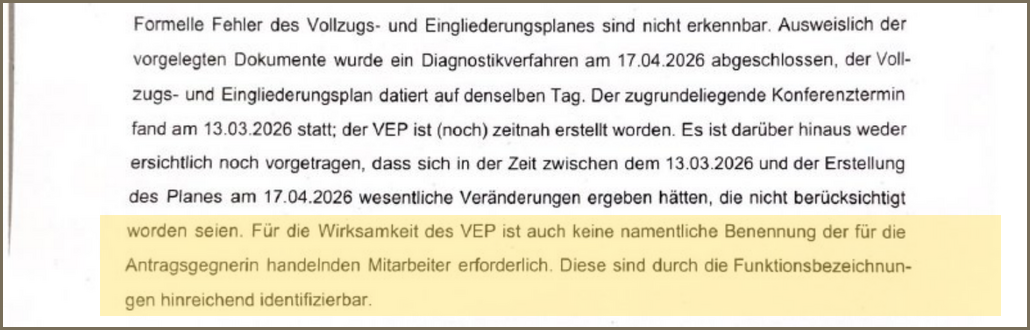
‘…sufficiently identifiable through their functional designations.’
The order answers the question of the name. The question of the signature remains unanswered — these are two different questions. If this holds: A paper can determine years of custody without anyone signing responsibility for it.
Who was responsible for preparing the diagnostic procedure of 12.03.2026 — and why is their name not beneath it?
Who can answer: JVA Moabit · Senate Department for Justice (§ 151 StVollzG) · Petitions Committee (§ 5 para. 1 points a, b PetG Bln)
N-11
The basis that cannot be examined
Quotation from the diagnostic procedure
“An application for a judicial decision against the diagnostic procedure is not possible.” ‘In principle, a need for therapeutic treatment is identified. An indication for treatment is, however, … not established, as they would currently have little prospect of success.’
The document from which all negative assessments originate cannot, according to its own instructions, be challenged in court. If this holds: The basis is not examined, only what is built upon it — and a treatment need is identified without treatment being offered, the absence of which is later held against the person.
If treatment is not offered at all because it is considered unlikely to succeed — by what route is the ‘work on the offence’ to take place whose absence supports refusal of release?
Who can answer: Landgericht Berlin I (Berlin Regional Court I) in the complaint on points of law (Rechtsbeschwerde) · Senate Department for Justice · Petitions Committee (§ 5 para. 1 point b, § 10 para. 3 PetG Bln)
N-12
An expunged conviction, contrary to its own warning
Quotation
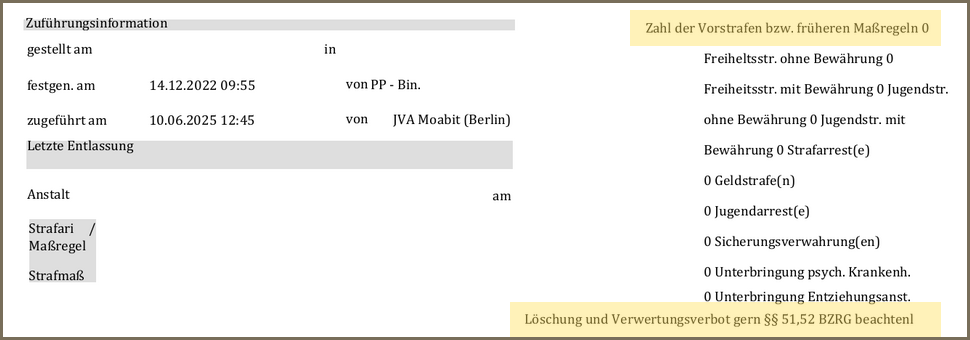
‘Number of previous convictions or previous measures: 0’ … ‘Observe deletion and the prohibition on use under §§ 51, 52 BZRG!’ — personal record of JVA Heidering, 29.05.2026 ‘…reveals a fundamental readiness for dissocial action…’ — diagnostic procedure, p. 12, derived from a conviction in 2000
§§ 51, 52 BZRG — prohibition on use of expunged entries
A character trait is inferred from an expunged conviction subject to an express prohibition on use and passes through three levels of decision-making. If this holds: Expungement in the Federal Central Register has no effect once an official document mentions the expunged entry.
On what basis is a prohibition on use expressly noted in the same set of files disregarded in that set of files?
Who can answer: Kammergericht (Berlin Higher Regional Court) in proceedings on the complaint on points of law (Rechtsbeschwerde) · Petitions Committee (§ 5 para. 1 point b, § 7 para. 4 PetG Bln)